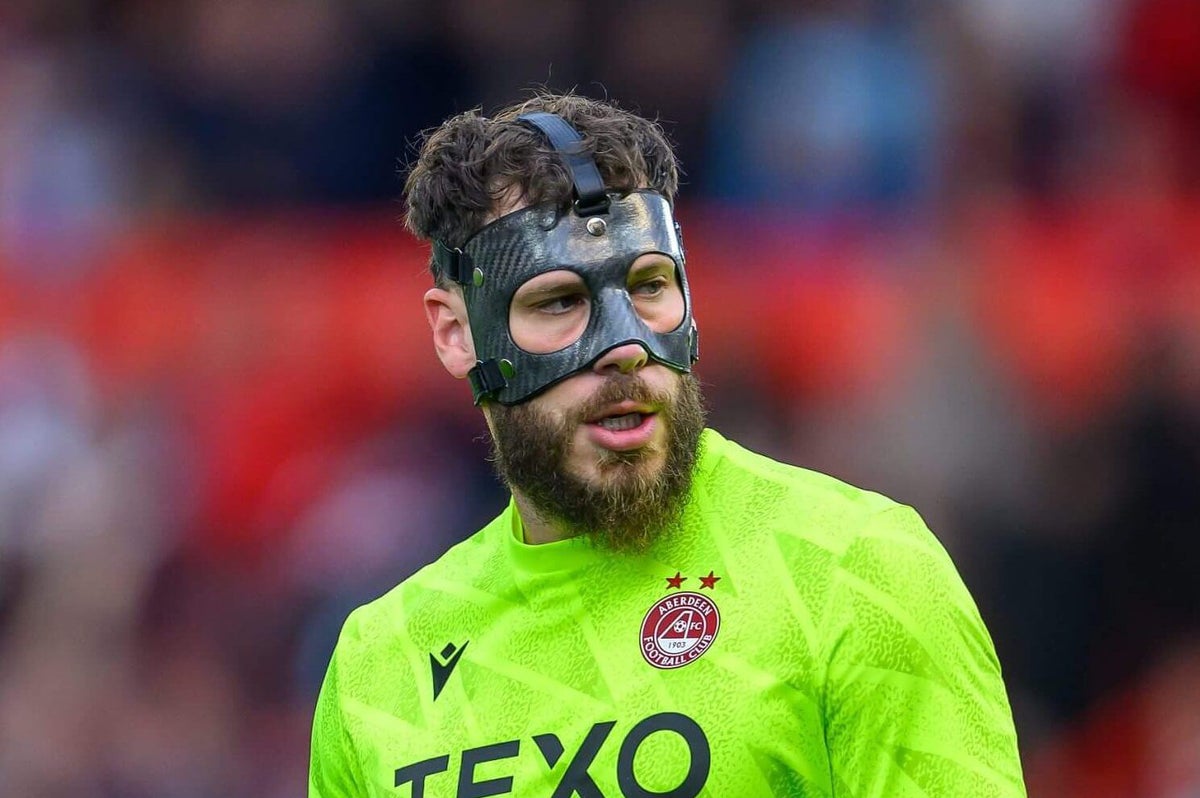
Scottish football has long been a theater for the unexpected, but few spectators at Pittodrie on Saturday could have anticipated a moment of high-wire audacity from their own goalkeeper. In a sport where goalkeepers are often coached to prioritize safety above all else, Aberdeen’s Marius Muller decided to rewrite the manual, producing a piece of skill that has since captured the attention of the global football community.
What happened
The incident occurred during the 38th minute of Aberdeen’s second-round League Cup clash against Dundee. With the scoreline still locked at 0-0, the Aberdeen defense was forced to deal with a long ball played over the top. Left-back Nesta Guinness-Walker collected the ball and played a routine backpass to Muller, who was positioned just a few yards from his goal line.
Faced with an oncoming Dundee attacker and the ball moving toward his weaker left foot, Muller opted against a conventional clearance. Instead, the German goalkeeper executed a perfectly timed rabona, crossing his right leg behind his left to loft the ball 40 yards up the pitch. The audacity of the maneuver left the stadium in a state of brief, confused silence before a mix of laughter and cheers broke out. Muller, seemingly unfazed by the risk he had just taken, simply jogged back into his goal as if such a flourish was a standard part of his repertoire.
Context
Muller’s flamboyant display of technique comes at a time when the role of the goalkeeper is under more scrutiny than ever. While modern keepers are expected to be proficient with their feet, the “rabona” — a skill usually reserved for high-priced wingers or playmakers — is almost never seen within one’s own six-yard box.
The reaction from the sidelines was telling. Aberdeen manager Stephen Robinson, known for his pragmatic and disciplined approach to the game, was seen shaking his head in disbelief after the final whistle. The contrast between the manager’s stoic North Irish temperament and Muller’s German flair provided a subtext to the event that fans found particularly entertaining. Social media was quickly flooded with footage of the clearance, with supporters questioning their own eyes as they watched a goalkeeper perform a trick more commonly associated with the likes of Ronaldinho or Neymar.
This “element of insanity,” as famously described by German legend Oliver Kahn, seems to be a trait Muller shares with his compatriots. While the clearance was successful in terms of distance and accuracy, the proximity of Pittodrie to the turbulent winds of the North Sea made the decision statistically risky.
Why it matters
The incident sparks a wider conversation about the balance between entertainment and efficiency in professional football. While Muller’s clearance found its target, the act of showboating in a scoreless game is often viewed as a “divisive” act by coaching staff.
The debate echoes recent comments made by Manchester City manager Pep Guardiola regarding Rayan Cherki. Guardiola, a staunch advocate for technical excellence, has often argued that the greatest players, such as Lionel Messi, rarely rely on flashy maneuvers. For Guardiola, the height of skill is found in the perfection of simple actions. When a player chooses a complex solution like a rabona over a simple pass, they invite unnecessary risk.
However, for the fans, Muller’s moment provided a rare flash of pure theater. In an era where football can sometimes feel overly programmed and tactical, the sight of a goalkeeper defying convention to pull off an “outrageous” skill serves as a reminder of the game’s capacity for joy and surprise. Whether Muller will be encouraged to repeat the feat in a high-stakes league match remains to be seen, but for one afternoon in Aberdeen, he was the most talked-about man in Scottish football.