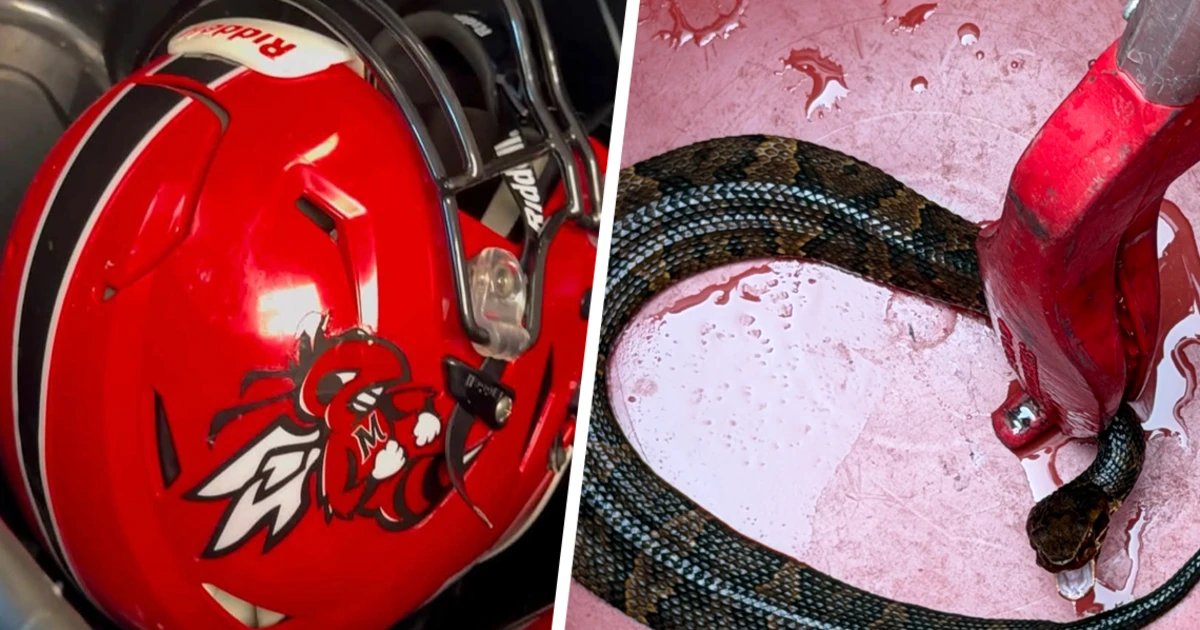
In the world of high school athletics, players are coached to keep their heads on a swivel and expect the unexpected. However, a student-athlete at Maumelle High School in Arkansas recently encountered a threat far more stealthy than an opposing linebacker. For nearly an hour during a routine practice session, a football player wore his helmet while a venomous snake was coiled inside the padding, just inches from his head.
What happened
The incident occurred last Thursday as the Maumelle football team began their standard afternoon drills. The player involved participated in warmups and initial practice segments for approximately sixty minutes before noticing something was wrong. According to school officials, the student felt an unusual movement within his headgear, prompting him to remove it for a closer look.
Underneath the protective padding, he discovered a two-foot-long snake that had managed to wedge itself into the tight space. The athletic staff was immediately alerted to the situation. Maumelle High School Athletic Director Kirk Horton described the atmosphere as one of total disbelief. Horton, who has spent a decade in the field of athletics, remarked that the chances of such an occurrence were incredibly slim, noting that he felt he had a better chance of winning the lottery than witnessing a venomous reptile hiding inside a player’s equipment.
Context
Following the discovery, the school contacted Maumelle Animal Services to safely manage the situation. While initial reports suggested the intruder might be a copperhead, Animal Services Director Chris Davis confirmed upon arrival that the creature was actually a cottonmouth, also known as a water moccasin.
The cottonmouth is the second most venomous snake species native to Arkansas. These reptiles are notorious for seeking out dark, cool, and enclosed environments, which explains why the interior of a padded football helmet proved to be an attractive hiding spot. After the snake was retrieved, animal control officers placed it in a secure tote and relocated it to a nearby river habitat, away from the school campus.
Why it matters
This startling event serves as a critical safety reminder for athletes, coaches, and parents alike. While the student-athlete was fortunate to escape the encounter without being bitten, the situation could have resulted in a severe medical emergency. Cottonmouth venom is hemotoxic, meaning it breaks down blood cells and can lead to significant tissue damage or worse if not treated immediately with antivenom.
In response to the incident, the Maumelle Animal Shelter issued a public advisory on social media. They urged anyone using outdoor gear—ranging from football helmets and cleats to gardening gloves and boots—to perform a thorough inspection before putting the items on. As wildlife often seeks shelter in gear left in garages or outdoor storage areas, taking a few seconds to shake out equipment can prevent dangerous encounters. The school’s experience highlights that even in a controlled environment like a high school practice field, situational awareness remains the best defense against the hazards of local wildlife.