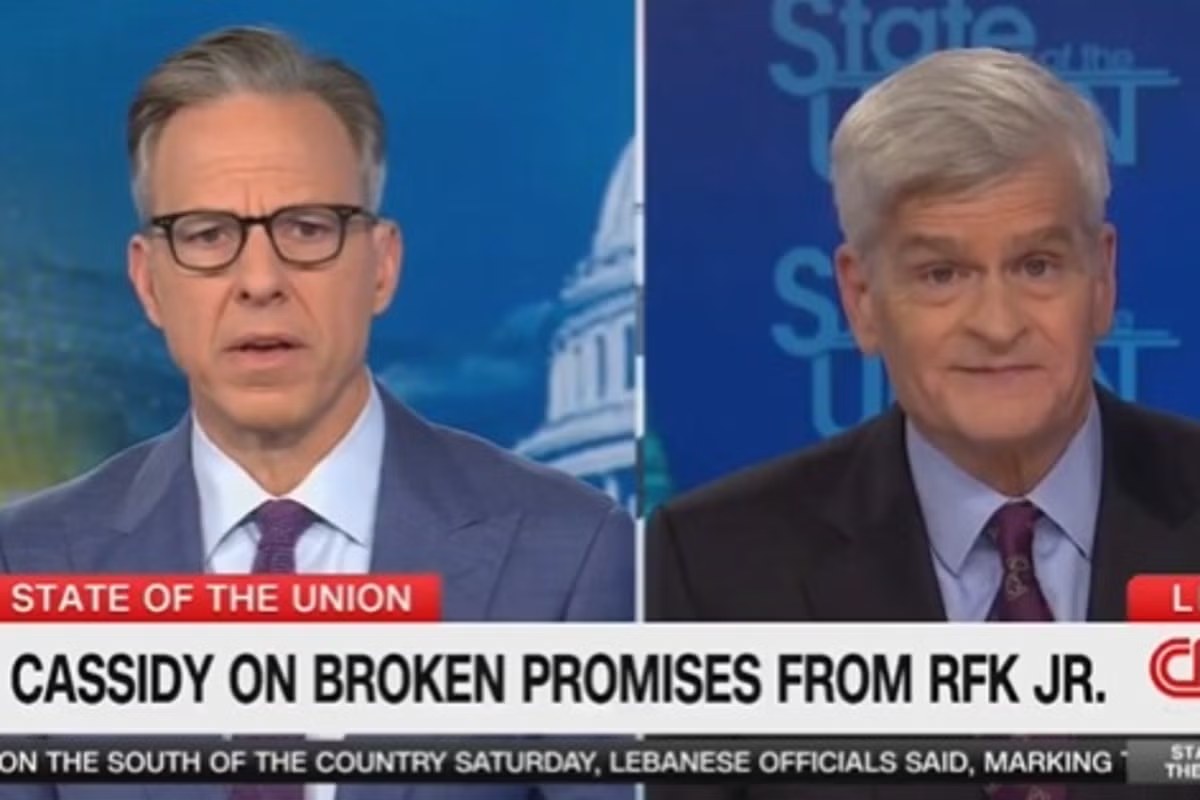
Senator Bill Cassidy, a Republican from Louisiana and a trained physician, has publicly broken ranks with the Trump administration over its recent overhaul of the federal vaccination schedule and the rhetoric surrounding it. During a recent appearance on CNN’s “State of the Union,” Cassidy characterized President Donald Trump’s comments regarding the purported dangers of vaccines as “crazy” and “stupid,” while expressing deep concern over the practical and medical implications of new federal health directives.
What happened
The friction reached a boiling point following an executive order from the Trump administration that fundamentally alters how infants and children receive routine immunizations. The new policy mandates that shots be divided into three separate categories, effectively requiring families to schedule multiple doctor’s visits for what were previously consolidated vaccinations.
During his interview with Jake Tapper, Cassidy did not hold back in his assessment of the President’s recent rhetoric. At a signing ceremony for the order, President Trump repeated debunked claims linking childhood vaccinations to autism and suggested that Americans were healthier before the era of widespread immunization. Cassidy, who has spent decades in the medical field, agreed with the characterization of these claims as “crazy” and “stupid,” noting that if the potential health consequences were not so tragic, the situation would be laughable.
Despite his harsh criticism of the policy, Cassidy remained defensive regarding his own political role in the administration’s health agenda. When pressed by Tapper on whether he regretted his vote to confirm Robert F. Kennedy Jr. as the Secretary of Health and Human Services (HHS), Cassidy avoided a direct apology. Instead, he argued that one must “live life living forward,” even while acknowledging that Kennedy may have misled him about his intentions during the confirmation process.
Context
The controversy centers on the administration’s decision to upend the established federal vaccine schedule, a move heavily influenced by HHS Secretary Robert F. Kennedy Jr. For over two decades, Kennedy has been a prominent skeptic of the current vaccination framework, often promoting theories that have been rejected by the broader scientific and medical communities.
The new order requires a more spread-out administration of vaccines. From a medical standpoint, this moves away from the “combination” approach that has been the standard for years. From a logistical standpoint, it places a significantly higher burden on parents. Cassidy pointed out that for working-class families, the requirement for additional doctor’s visits represents a major hurdle, involving more time off work, higher co-pays, and increased transportation costs.
Scientific consensus, supported by organizations such as the CDC and the American Academy of Pediatrics, maintains that there is no link between vaccines and autism. Furthermore, historical data confirms that the advent of childhood vaccination schedules led to a dramatic decrease in infant mortality and the near-eradication of several debilitating diseases.
Why it matters
Senator Cassidy’s critique highlights a growing rift between the medical community and the current administration’s health policy. As a Republican doctor, Cassidy’s opposition suggests that the administration’s “Make America Healthy Again” (MAHA) initiative may be facing internal skepticism from those who prioritize traditional evidence-based medicine.
The primary concern for public health experts is that these policy changes will lead to a significant decline in immunization rates. By making the process less convenient and more expensive, the government risks creating a barrier to entry for preventative care. Lower vaccination rates could lead to the resurgence of preventable diseases, such as measles or polio, which would place a massive strain on the national healthcare system.
Furthermore, the mainstreaming of vaccine misinformation from the highest levels of government threatens to erode public trust in medical institutions. Cassidy argued that the focus should remain on positive policies that increase immunization rates rather than rhetoric that creates unnecessary fear. As the administration moves forward with these changes, the political and social fallout will likely continue to spark debate over the balance between individual choice and collective public health security.