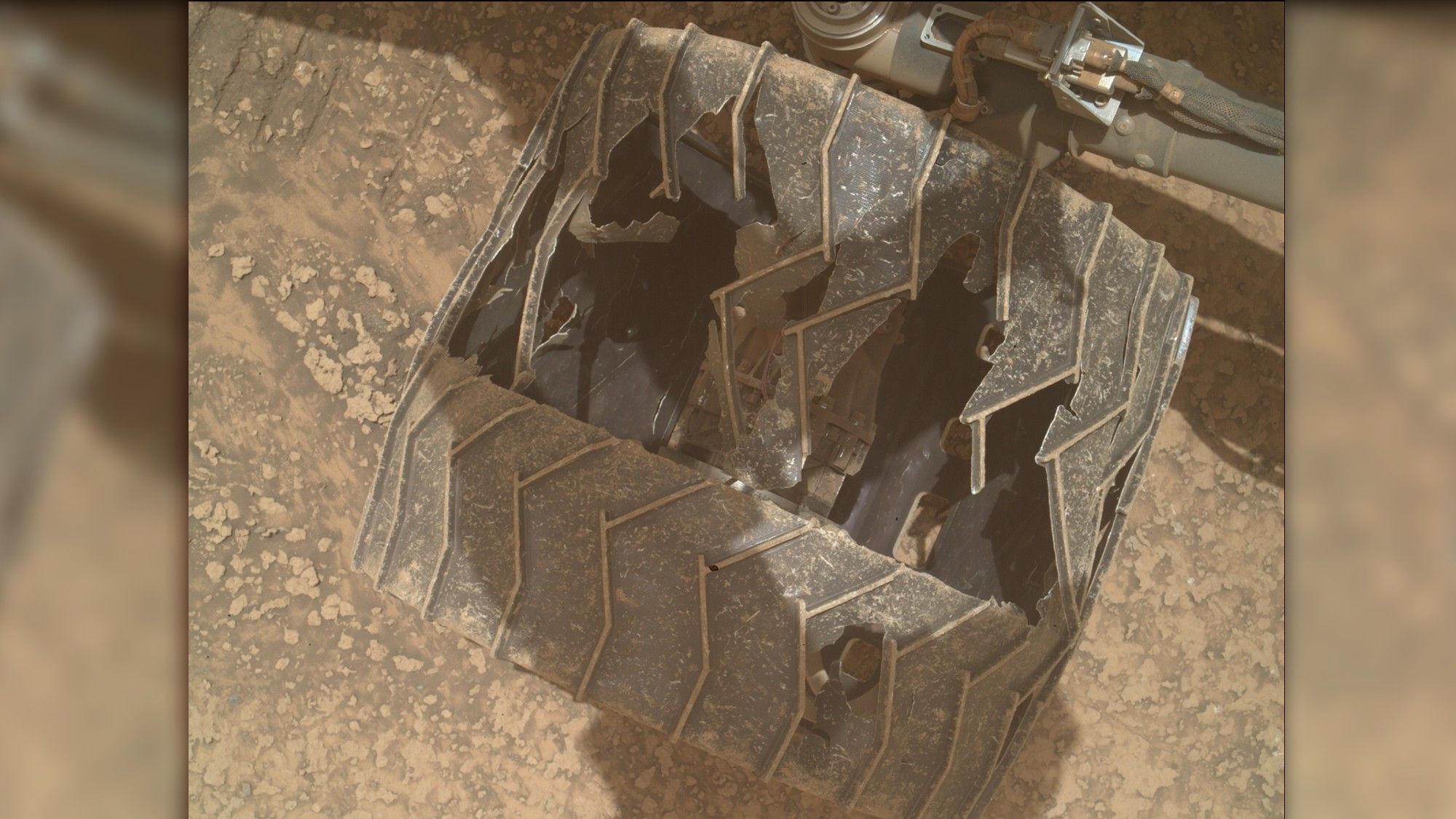
NASA’s Curiosity rover has long been a symbol of endurance in deep-space exploration, but recent imagery suggests that the Martian environment is finally catching up with the veteran machine. After nearly fourteen years of traversing the jagged, wind-scoured terrain of the Red Planet, the rover’s aluminum wheels are showing significant signs of structural fatigue. New photographs transmitted back to Earth provide a stark look at the physical toll extracted by one of the most hostile environments in the solar system.
What happened
On July 24, 2026, mission controllers at NASA’s Jet Propulsion Laboratory (JPL) conducted a routine visual inspection of the Curiosity rover’s six wheels. The resulting “Photo of the Day” images reveal a series of pronounced cracks and missing segments in the rover’s treads, also known as grousers. These aluminum components are essential for maintaining traction as the rover climbs the steep, rocky slopes of Mount Sharp.
The wear and tear visible in the latest high-resolution frames show that the thin aluminum skin between the grousers has continued to puncture and tear. While NASA engineers have been monitoring these developments for years, the most recent images highlight a mission that has far outlasted its original design specifications, surviving long enough to see its hardware physically degrade under the pressure of continuous operation.
Context
Curiosity landed in Gale Crater in August 2012 with a primary mission slated to last just two Earth years. Its goal was to determine if Mars ever possessed the chemical ingredients and environmental conditions to support microbial life. Having successfully answered that question early in its journey, the rover began a multi-year ascent of Mount Sharp, a five-kilometer-tall mountain in the center of the crater.
The Martian surface is littered with “ventifacts”—rocks sharpened into jagged edges by eons of wind erosion. These obstacles have been particularly punishing to Curiosity’s wheels, which were designed to be lightweight to meet launch requirements but are only about as thick as a U.S. nickel. In response to early signs of damage detected in 2013, NASA implemented a “Wheel Wear Monitoring” protocol, using the rover’s Mars Hand Lens Imager (MAHLI) to take periodic close-up photos. Engineers also developed software updates to adjust the speed of the wheels based on the terrain, reducing the stress caused by uneven pressure.
Why it matters
The degradation of Curiosity’s wheels is more than just a matter of maintenance; it is a testament to the rover’s longevity and a vital case study for future planetary missions. Despite the visible holes and cracks, the rover remains fully operational. NASA’s ability to keep Curiosity moving across several miles of treacherous terrain with compromised hardware demonstrates the ingenuity of remote engineering and the resilience of the platform.
Furthermore, the lessons learned from Curiosity’s wheel damage have already influenced the design of subsequent missions. The Perseverance rover, which landed on Mars in 2021, features wheels with a significantly different design—thicker skins, more durable alloys, and a refined tread pattern—to avoid the same pitfalls.
As Curiosity continues its climb, every new image of its worn treads serves as a reminder of the harsh realities of long-term space exploration. While the wheels may be battered, the rover continues to provide invaluable data about the history of water on Mars, proving that even a damaged machine can continue to expand the horizons of human knowledge.