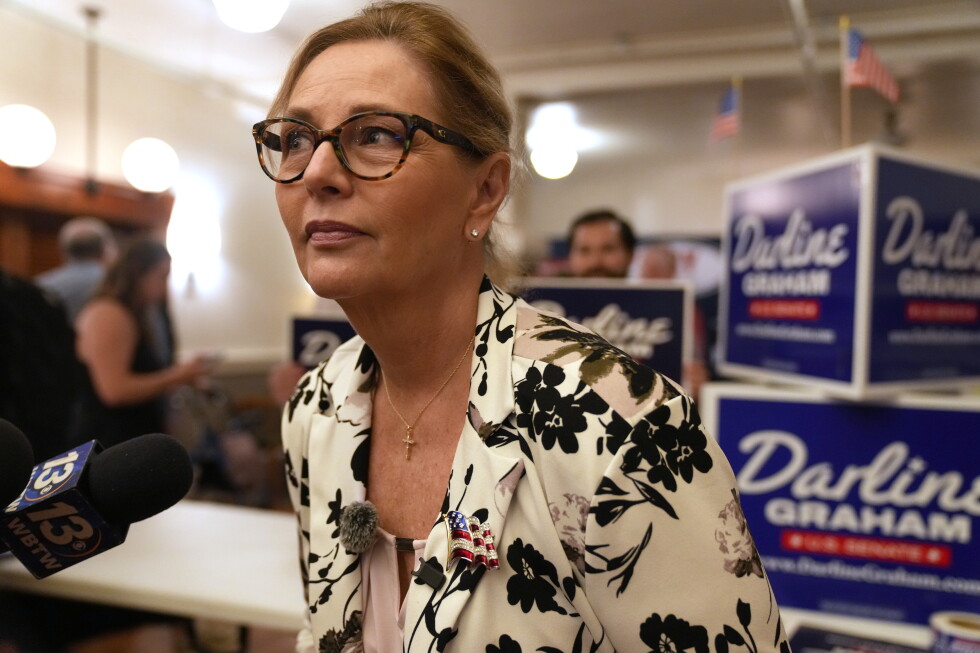
As South Carolina voters prepare to head to the polls this Tuesday, the political landscape in the Palmetto State finds itself at a unique crossroads. Darline Graham, who stepped into the U.S. Senate via appointment following the sudden passing of her brother, long-serving Senator Lindsey Graham, is now facing her first major electoral test. In a crowded Republican field, Graham is attempting to prove that her deep personal connection to one of the state’s most influential political figures is enough to secure a mandate from the voters.
What happened
The upcoming special Republican primary marks a pivotal moment for Darline Graham’s nascent political career. Following the death of her brother, who had recently been nominated for a fifth term in the Senate, Graham was appointed to fill the vacancy. Now, she is campaigning to win the seat in her own right. Over the past few weeks, Graham has maintained a rigorous schedule, appearing at candidate forums in Florence and Lexington, and participating in televised debates in Columbia.
The primary is far from a coronation. Graham is competing against several other Republican challengers in a race that has drawn significant attention across the state. While she has the advantage of name recognition and a recent record in the seat, her opponents are positioning themselves as seasoned alternatives with established political backgrounds. The results of Tuesday’s vote will determine if the “Graham” name still carries the same weight in South Carolina that it has for the last two decades.
Context
To understand the current stakes, one must look at the vacuum left by the late Senator Lindsey Graham. A fixture in national and state politics, the elder Graham died unexpectedly due to a tear in his aorta. His death occurred after he had already secured the GOP nomination for another term, necessitating a special process to select a replacement for the November ballot.
Until her appointment, Darline Graham was a relatively unknown figure in the state’s political hierarchy. While she was frequently seen at her brother’s side during his many campaigns and official functions, she had never held public office herself. This lack of a personal political track record has become a central theme of the primary campaign.
Voters in South Carolina have expressed a complex mix of emotions regarding her candidacy. Many who attended recent Republican events speak highly of her character and her dedication to her brother’s legacy. However, there is a palpable sense of hesitation among the electorate. Some regular primary voters have questioned whether she possesses the specific qualifications and experience required for a full six-year term in the United States Senate, or if her appointment was merely a symbolic gesture to honor her brother’s service.
Why it matters
This primary is a major test of legacy politics in the modern Republican Party. It raises a fundamental question: can a family name and proximity to power overcome a lack of traditional political experience? For the South Carolina GOP, the outcome will signal whether the party is ready to move in a new direction or if it prefers the continuity offered by the Graham family.
Furthermore, the winner of this crowded primary will be tasked with defending a seat that is vital to the Republican strategy in Washington. With the special election drawing national eyes, the ability of the chosen candidate to unite the party after a competitive primary will be essential. Darline Graham’s struggle to emerge from her brother’s shadow while simultaneously leveraging his popularity highlights the difficult balancing act required of political heirs.
As the campaign enters its final hours, the focus remains on whether the warmth South Carolinians felt for Lindsey Graham will translate into votes for the sister who now seeks to carry his mantle forward. Tuesday’s primary will finally reveal if Darline Graham can transform from a grieving sister and temporary appointee into a political powerhouse in her own right.