Jared Leto has long been known for his transformative acting roles and his leadership of the rock band Thirty Seconds to Mars, but his relationship with his most devoted fans has often blurred the lines between music fandom and spiritual devotion. Long before he faced a series of serious sexual misconduct allegations, Leto’s “Mars Island” retreats had already sparked a global conversation regarding the nature of his influence and the peculiar, cult-like atmosphere he cultivated.
What happened
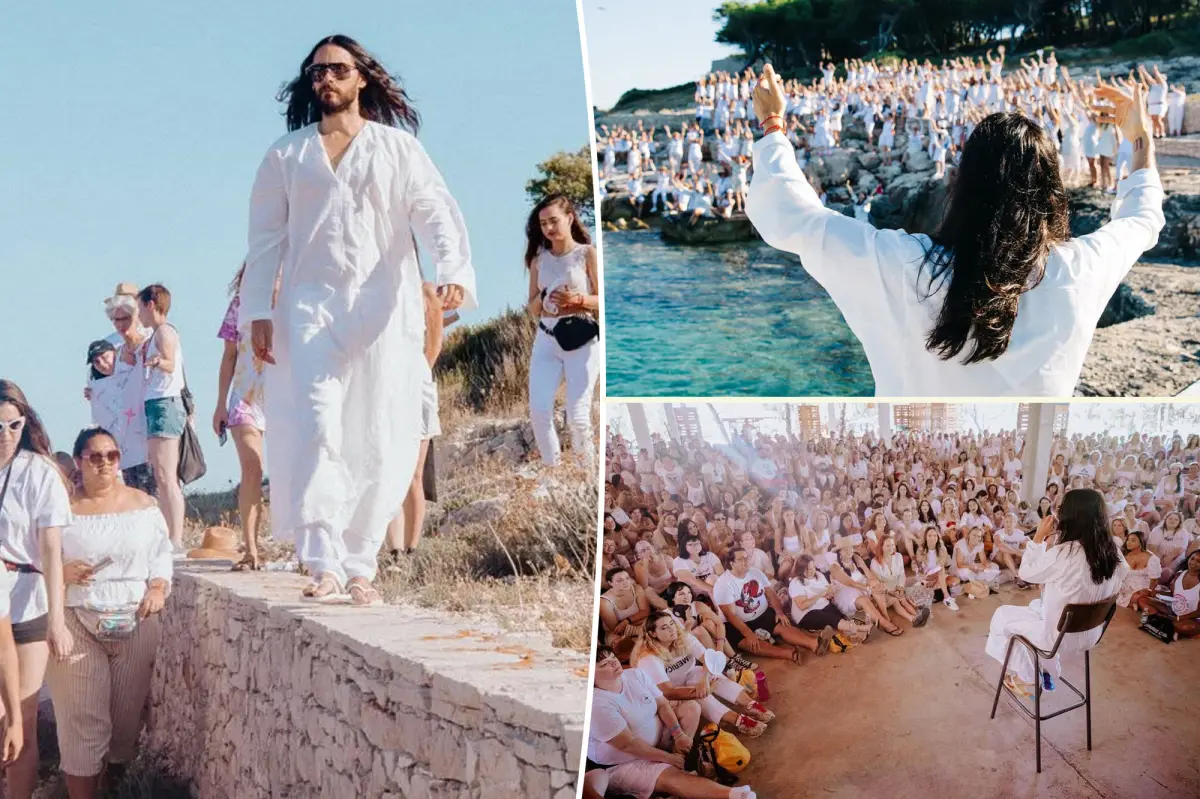
The controversy surrounding Leto’s leadership style reached a peak several years ago during a wellness retreat held on the private island of Obonjan, Croatia. In August 2020, Leto hosted an event for “The Echelon”—the official name for the Thirty Seconds to Mars fanbase. The retreat was advertised as an alcohol-free, spiritual experience where attendees could participate in yoga, swimming, and sunbathing while celebrating the band’s music.
However, the imagery that emerged from the event fueled intense speculation. Photographs showed a demographic primarily comprised of women dressed entirely in white, navigating the island alongside Leto, who also wore white caftans. In one particularly striking image, the “House of Gucci” actor stood atop a cliff with his arms raised, while a crowd of followers below mirrored his stance. The band’s own marketing team leaned into the controversy, even posting on social media with the caption, “Yes, this is a cult,” accompanied by a hashtag for Mars Island.
The exclusivity of the event was also a point of contention. To gain access to this three-day “immersive experience,” fans were reportedly required to pay upwards of $6,499. This high entry price, combined with the ritualistic nature of the activities—which included chanting and barefoot meditation sessions led by Leto—led many observers to question the power dynamics at play.
Context
Mars Island was not an isolated incident but rather the culmination of a lifestyle brand Leto had been building for years. Before the Croatian retreat, the band established “Camp Mars” in Malibu, California, in 2015. These weekend events featured traditional camp activities like hiking and archery, but they were anchored by nightly performances referred to as the “Church of Mars.”
While these events were initially viewed as eccentric celebrity branding, they have recently been re-examined in a much darker light. A 2025 report by Air Mail and a subsequent BBC documentary brought forward allegations from multiple women who accused Leto of sexual improprieties. These accounts suggest that Leto’s behavior toward young fans—some of whom were teenagers at the time—was predatory. According to the documentary, at least four women have come forward with specific accusations of misconduct.
Leto, now 54, has categorically denied all allegations of sexual impropriety. Despite his denials, the reports have cast a shadow over the “spiritual” retreats of the past, suggesting that the “cult” aesthetic may have been more than just a playful marketing gimmick.
Why it matters
The evolution of Jared Leto’s public image from an eccentric Oscar winner to a figure at the center of a sexual assault scandal highlights the potential dangers within high-intensity fan communities. When a celebrity creates a “spiritual” environment that discourages outside influence—often referred to as a “high-control group” dynamic—it can create a vacuum where boundaries become difficult to maintain.
The Mars Island saga serves as a cautionary tale about the intersection of celebrity worship and wellness culture. While the band may have used “cult” terminology to foster a sense of belonging and exclusivity, the recent allegations suggest that such environments can sometimes mask deeper issues of exploitation. As the legal and social fallout continues, the focus remains on whether the structures Leto built for his fans were designed for community or for control. The transition from “Church of Mars” concerts to a full-scale documentary investigation marks a significant shift in how the industry and the public view the responsibilities of influential figures toward their most loyal supporters.