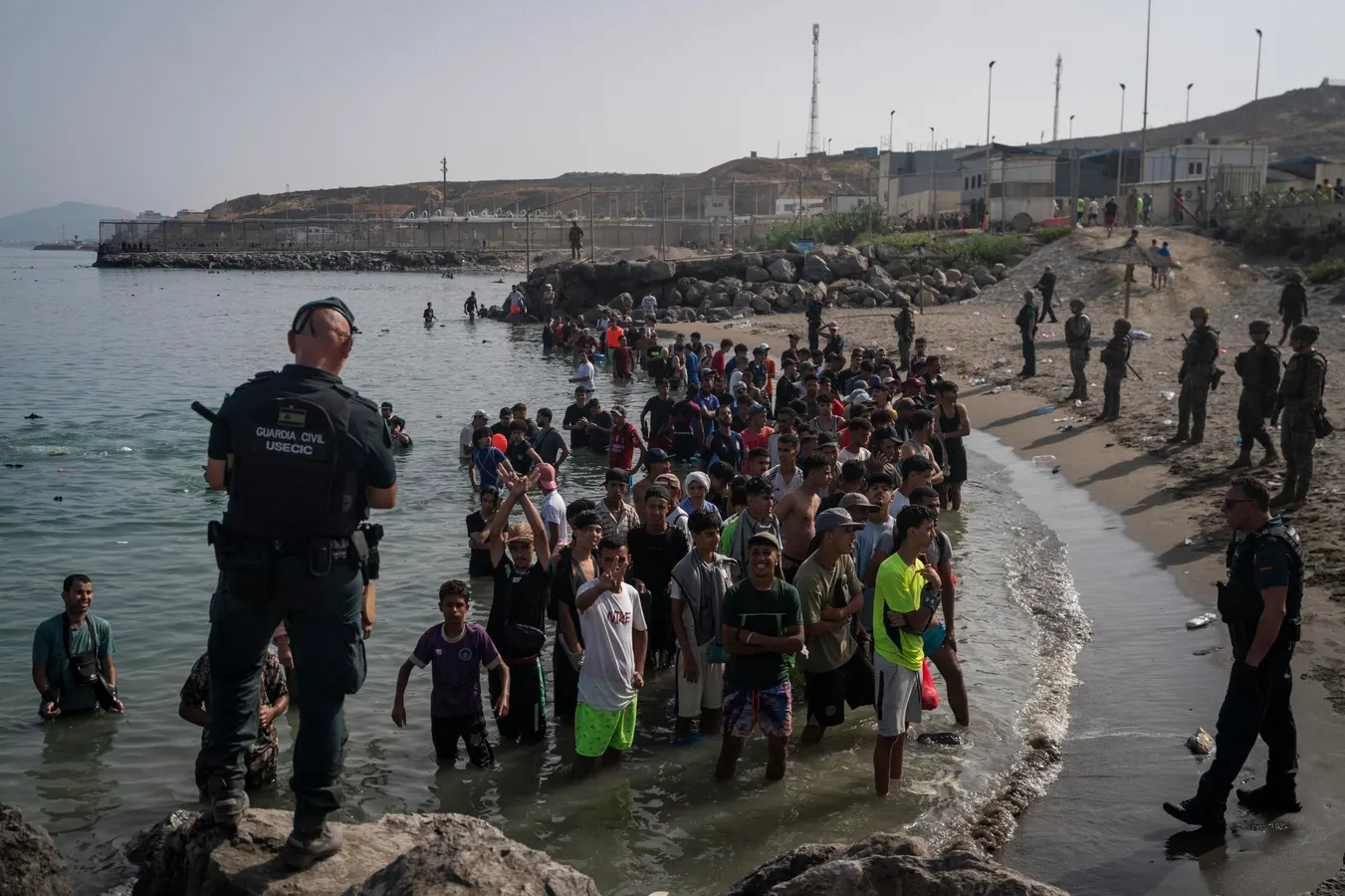
A sudden and massive influx of migrants into the Spanish territory of Ceuta has triggered a severe humanitarian crisis and ignited a fierce political debate across Europe. Over the course of a single day, approximately 60,000 people crossed from Morocco into the small enclave, overwhelming local resources and prompting the Spanish government to deploy the military. While many arrivals have since been repatriated, the scale of the event has left authorities struggling to manage the remaining population and the tragic loss of life at the border.
What happened
On Thursday, Ceuta—a Spanish city located on the coast of North Africa—witnessed an unprecedented breach of its borders. By Friday afternoon, Spanish officials reported that while roughly 48,300 migrants had returned to Morocco, thousands remained in the territory. The surge turned deadly, with at least 57 people confirmed dead from drowning or crushing injuries sustained while attempting to scale border defenses along the breakwater.
Spanish Prime Minister Pedro Sánchez categorized the event as a violation of territorial integrity, deploying troops to restore order and assist local police. The crisis resonated throughout Europe as neighboring nations moved to protect their own borders. France announced increased surveillance and police presence at its border with Spain, while Italy temporarily suspended passport-free travel agreements with Spain, citing the need to safeguard national security.
The event also became a viral flashpoint on social media. High-profile figures, including billionaire Elon Musk, labeled the situation an “invasion,” comparing the footage of the surge to apocalyptic films. Domestically, the leader of Spain’s far-right Vox party, Santiago Abascal, used the event to heavily criticize the current administration, accusing the government of failing to protect the nation’s borders.
Context
Ceuta and its sister city Melilla are unique because they are the only European Union territories located on mainland Africa. Belonging to Spain since the 16th century, these enclaves have long been magnets for migrants seeking entry into Europe. The causes of this latest surge are complex, involving a mix of economic hardship in Morocco and the spread of misinformation. Reports suggest that human traffickers and social media posts falsely claimed that arrivals would be granted legal status due to recent court rulings.
There is also a significant geopolitical dimension to the crisis. Many analysts believe Morocco uses migration pressure as a tool of diplomacy. Tensions between Spain and Morocco often center on the disputed territory of Western Sahara. Historically, when diplomatic relations sour, border controls have been known to relax. In 2021, a similar event occurred where 8,000 people crossed into Ceuta in two days following a dispute over the medical treatment of a Sahrawi separatist leader in Spain. Witnesses in the most recent surge claimed that Moroccan authorities actively encouraged them to cross, though both nations have officially denied that the event was politically engineered.
Why it matters
The situation in Ceuta highlights the fragility of European border security and the strain placed on small territories that lack the infrastructure to manage mass migration. Juan Jesús Vivas, the President of Ceuta, described the current state as an “absolute humanitarian and social emergency,” noting that the city simply does not have the food or housing required to support the thousands who remain.
Politically, the crisis has weakened Prime Minister Sánchez’s standing with his detractors. Opposition parties point to his government’s recent efforts to provide legal status to half a million undocumented immigrants as a “pull factor” that encourages dangerous crossings. Beyond Spain, the reaction from France and Italy demonstrates how a localized border breach in North Africa can have a domino effect, leading to the tightening of internal European borders and the temporary suspension of free movement within the EU. As the death toll rises and resources dwindle, the event serves as a stark reminder of the humanitarian risks and the complex international negotiations required to manage modern migration.