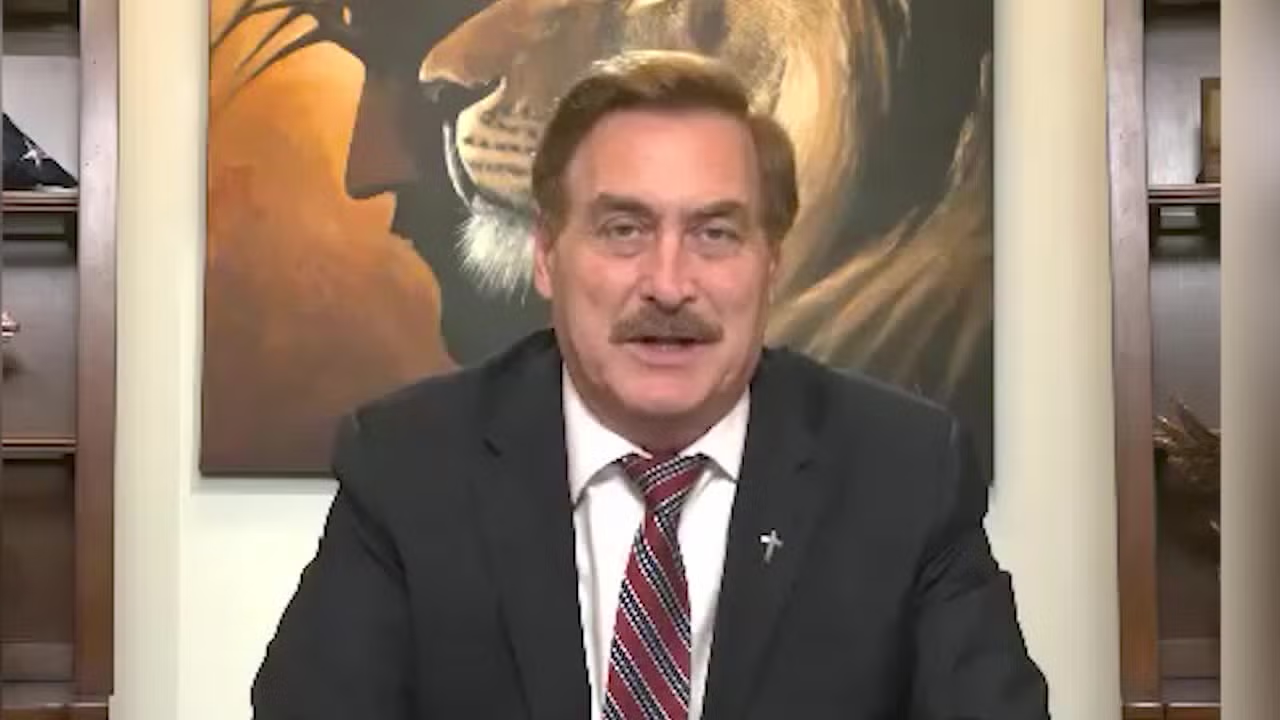
Mike Lindell, the MyPillow executive and vocal advocate for election reform, has announced a significant legal and financial initiative following his recent defeat in the Minnesota Republican gubernatorial primary. Rather than conceding the race to the declared winner, Lisa Demuth, Lindell is moving forward with a comprehensive, privately funded statewide recount. This move aims to scrutinize the results of the August 11 primary through a manual review of paper ballots, a process Lindell asserts is necessary to ensure the integrity of the state’s electoral system.
What happened
Following the certification of the primary results, which showed Lindell trailing Lisa Demuth by approximately 45,000 votes—a margin of roughly 11 percentage points—the Trump-endorsed candidate refused to acknowledge the loss. Instead, Lindell publicly declared on Wednesday that he would exercise his right under state law to request a full audit and hand count of every ballot cast in the Republican primary for governor.
Lindell has committed to covering all associated expenses personally, ensuring that the financial burden of this massive undertaking does not fall on Minnesota taxpayers. The decision to pursue a recount is rooted in what Lindell describes as “multiple anomalies” and “irregularities” identified by his team during an analysis of election-night reporting data. While the specific data points behind these claims remain under scrutiny, Lindell’s primary objective appears to be a total verification of the paper trail to compare against the digital tallies provided by voting machines.
Context
The primary race was a high-stakes contest for the future direction of the Minnesota Republican Party. Lisa Demuth secured the nomination despite Lindell’s high-profile endorsement from former President Donald Trump. While Demuth has been positioned as a strong candidate for the general election, Lindell’s refusal to concede has created a unique point of friction within the party.
Under Minnesota’s current election statutes, candidates have the legal standing to request audits and recounts, provided they are willing to provide the necessary funding if the margin of victory exceeds a certain threshold. Lindell is leveraging these specific provisions to bypass the standard certification process. His skepticism toward electronic voting systems is well-documented; throughout his campaign and in his national activism, he has frequently argued that machine-based counting is vulnerable to errors or interference. During his announcement, he explicitly stated that even if the recount does not shift the final outcome of the race, he views the process as a vital step toward a larger goal: the complete removal of voting machines from the electoral process.
Why it matters
This development is significant for several reasons, touching on both the logistics of Minnesota’s elections and the broader political climate. First, a statewide hand count of every ballot is an enormous logistical feat that will require significant coordination with local election officials. It serves as a real-world test of the state’s ability to conduct large-scale manual audits under intense public and political pressure.
Second, the move highlights a growing trend within certain political factions to bypass traditional concessions in favor of independent verification. By funding the audit himself, Lindell is setting a precedent for how private resources can be used to challenge public election outcomes. This could influence how future candidates handle narrow or even moderate losses, potentially making such recounts a standard feature of contested primaries.
Finally, the outcome of this audit will be closely watched by both supporters and critics of the current voting infrastructure. If the hand count matches the machine results, it may bolster public confidence in Minnesota’s technology. Conversely, any discrepancies found—regardless of whether they change the winner—will likely be used by activists to further the argument for returning to exclusively manual voting processes. As the general election approaches, the Republican party must also navigate the internal optics of a primary that remains unsettled in the eyes of one of its most prominent figures.