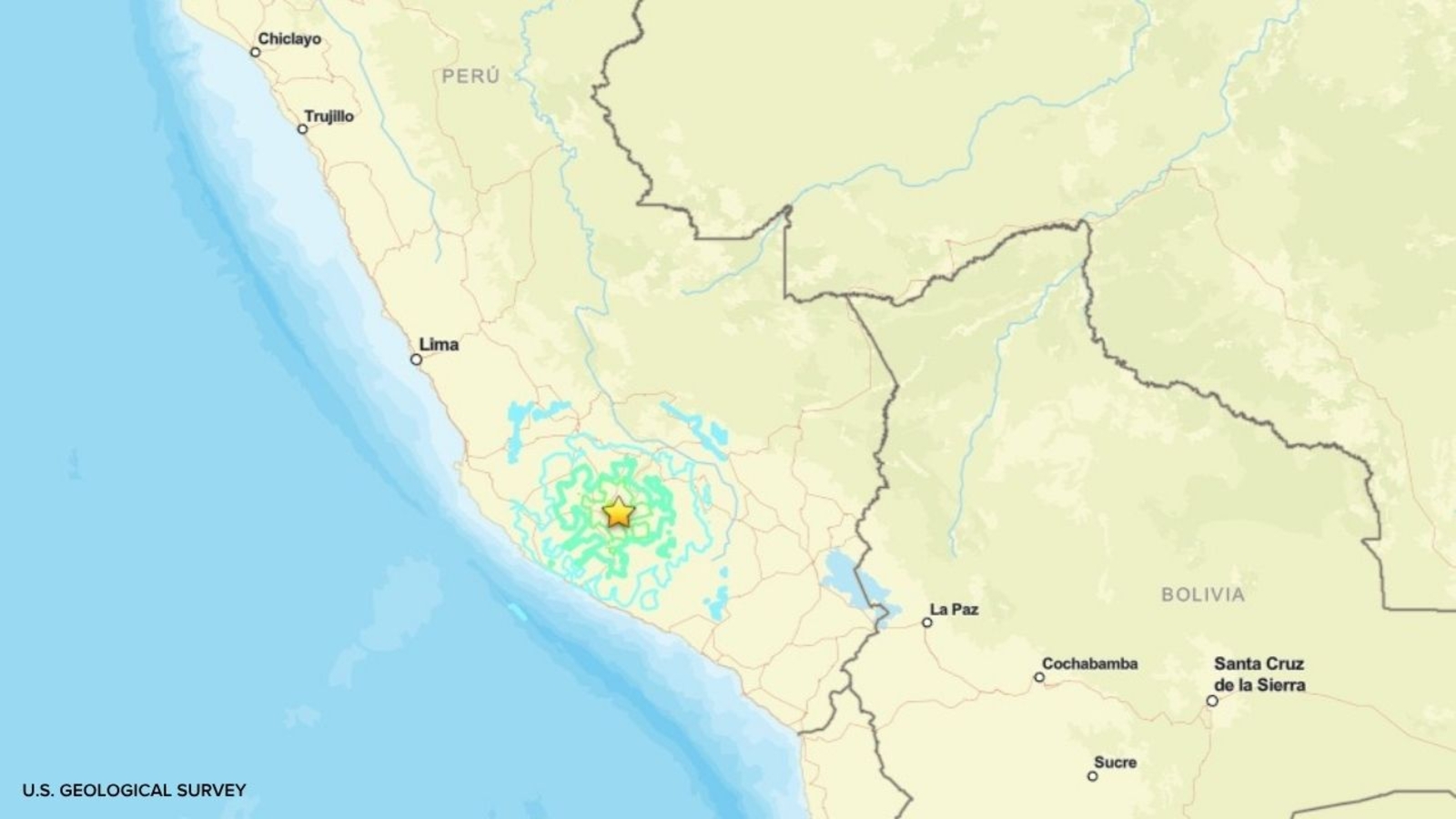
A powerful 6.7-magnitude earthquake rattled the southern highlands of Peru on Thursday afternoon, sending tremors through several regions and sparking immediate concern among residents. While the seismic event was significant in scale, initial reports from local authorities suggest that the country may have avoided a major humanitarian disaster. The earthquake, which struck in a relatively remote mountainous area, highlights the ongoing geological volatility of the South American nation.
What happened
According to data released by the U.S. Geological Survey (USGS), the earthquake occurred at approximately 1:00 p.m. local time (18:00 GMT). The epicenter was identified about 38 kilometers (24 miles) northwest of Upahuacho, a town located in the Parinacochas province within the Ayacucho region. Scientists recorded the quake at a depth of 66 kilometers (41 miles), a factor that often influences how much energy reaches the surface and the subsequent level of destruction.
The tremors were not confined to the epicenter alone. Residents in neighboring regions, including the coastal area of Ica and the southern city of Arequipa, reported feeling the ground shake. Despite the strength of the magnitude, the immediate aftermath brought a sense of relief. Luis Vásquez, the head of Peru’s Civil Defense, spoke with the local radio station RPP shortly after the event, stating that there had been no reports of damage to infrastructure or loss of life in the moments following the quake.
Similarly, Yony Reyes, the mayor of Parinacochas province, confirmed that the provincial capital remained stable with no reported casualties or significant structural failures. To further ease public anxiety, the Peruvian Navy issued a statement confirming that the earthquake did not meet the criteria to trigger a tsunami threat along the nation’s coastline.
Context
Peru is no stranger to seismic activity, as it is situated directly on the Pacific “Ring of Fire.” This horseshoe-shaped zone encircles the Pacific Ocean and is characterized by frequent earthquakes and volcanic eruptions resulting from the movement of tectonic plates. In Peru’s case, the subduction of the Nazca Plate beneath the South American Plate creates immense geological pressure that is periodically released through seismic events.
Historically, this movement has led to some of the most devastating natural disasters in the region. Most notably, in 2007, a massive 7.9-magnitude earthquake struck the Ica region. That event was catastrophic, resulting in nearly 600 deaths and destroying thousands of homes. Because of this history, any earthquake registering above a 6.0 magnitude serves as a stark reminder of the country’s vulnerability and the necessity of rigorous building codes and emergency preparedness.
Why it matters
The 6.7-magnitude earthquake on Thursday serves as a critical test for Peru’s emergency response systems and regional infrastructure. While the lack of immediate damage is fortunate, the event underscores the importance of the depth of an earthquake. Shallow earthquakes—typically those less than 30 kilometers deep—tend to be much more destructive than deeper ones of the same magnitude. At 66 kilometers deep, the energy of this specific quake was somewhat dissipated before reaching the surface, likely contributing to the minimal impact reported by Civil Defense.
Furthermore, these events emphasize the ongoing need for vigilance in urban planning and public education. In a region where seismic activity is an inevitability rather than a possibility, the speed and accuracy of communication between the USGS, the Peruvian Navy, and local mayors are vital. The fact that authorities were able to quickly rule out a tsunami and assess provincial damage helps prevent secondary crises, such as mass panic.
As recovery teams continue to monitor the remote areas of the Ayacucho region for any delayed reports of landslides or minor structural cracks, the event stands as a successful moment of crisis management. However, for the people living along the Andes, it is a reminder that the ground beneath them remains in constant, powerful motion.