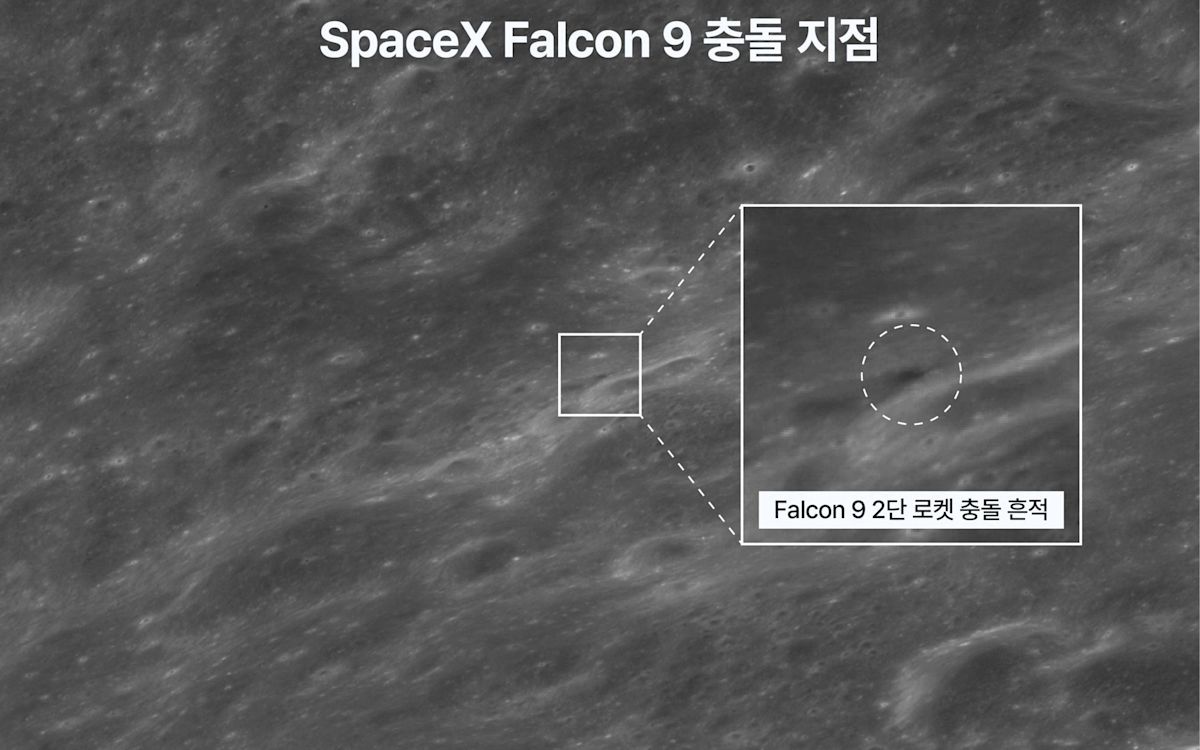
The lunar landscape has a permanent new feature following the high-speed impact of a SpaceX rocket component. For the first time, visual evidence of the collision has been released to the public, showcasing a fresh crater carved into the Moon’s surface by a discarded Falcon 9 upper stage. Captured by South Korea’s Danuri spacecraft, the “before and after” imagery provides a rare look at how human-made objects are beginning to leave a physical mark on the celestial bodies within our solar system.
What happened
The collision occurred after the rocket component spent more than a year drifting through the void of space. According to reports from South Korea’s AeroSpace Administration, the Danuri orbiter successfully documented the site during several passes over the impact zone. The imagery confirms that the debris struck the lunar surface at an estimated speed of 5,400 mph—approximately seven times the speed of sound.
Scientists had predicted the event with high precision, estimating that the impact would carry the kinetic energy equivalent to three tons of TNT. While the crash was anticipated by the global astronomical community, it was not visible to observers on Earth. Amateur astronomers using high-powered telescopes were unable to spot the impact, as the resulting flash was too faint to be detected from such a significant distance. However, orbital assets like Danuri and NASA’s Lunar Reconnaissance Orbiter were positioned to record the aftermath, with NASA expected to release additional high-resolution images in the near future.
Context
The debris responsible for the crater originated from a Falcon 9 mission launched in January of last year. The primary objective of that flight was to deploy two lunar landers into space. While the lower stage of the Falcon 9—the booster responsible for the initial liftoff—successfully returned to Earth’s atmosphere, the upper section remained in orbit. This upper stage, roughly the size of a five-story building and weighing approximately 4,000 kilograms, was responsible for the final push that sent the landers toward the Moon.
Once its fuel was exhausted, the empty shell became a “zombie” object, untethered and influenced only by the physics of the vacuum. SpaceX officials noted that a complex interplay of gravitational forces and solar activity eventually nudged the derelict hardware onto a collision course with the Moon. This was not a planned maneuver; rather, it was the result of the unpredictable nature of orbital dynamics over long periods.
Why it matters
While the crash posed no threat to Earth or its inhabitants, the event has reignited critical discussions regarding the management of space debris. As private companies and national space agencies increase the frequency of their missions, the region between the Earth and the Moon is becoming increasingly crowded with spent rocket stages, defunct satellites, and other fragments of hardware.
This incident serves as a stark reminder of the “litter” left behind by space exploration. While the Moon is already covered in millions of natural craters from billions of years of asteroid impacts, the addition of human-made craters highlights the growing footprint of terrestrial technology. For astronomers and environmentalists, the SpaceX impact is a case study in the need for better tracking systems and more sustainable “end-of-life” protocols for rocket components to prevent uncontrolled collisions in the future. Furthermore, studying these impacts allows scientists to better understand the composition of the lunar soil and how high-velocity strikes reshape the surfaces of airless worlds.