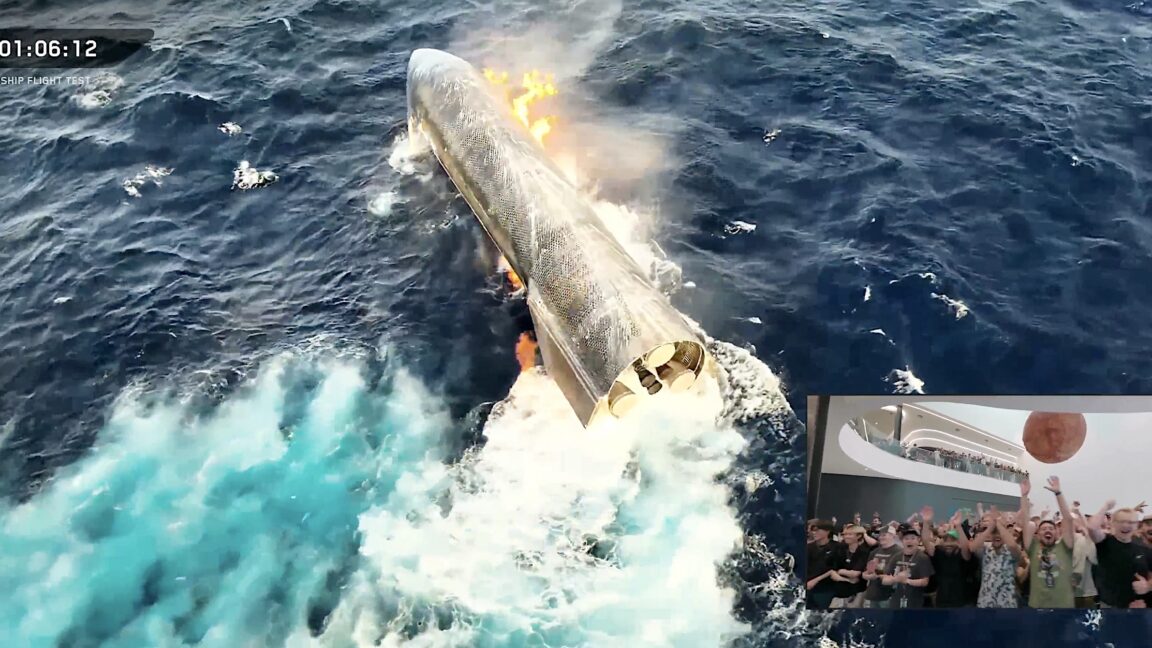
SpaceX has achieved another major milestone in its quest to develop the world’s first fully reusable launch system. Following a flawless demonstration of precision during its most recent Starship flight, the aerospace company is now preparing for an even more daring feat: returning the Starship spacecraft itself directly to the launch pad. The successful mission, which concluded with a controlled splashdown in the Indian Ocean, suggests that the vehicle’s thermal protection systems and guidance software are nearing the reliability required for land-based recovery.
What happened
During the 13th full-scale Starship test mission, the vehicle launched from the Starbase facility in Boca Chica, Texas. It traversed a suborbital trajectory that spanned halfway across the globe before executing a soft landing in a designated zone within the Indian Ocean. Unlike some previous iterations that struggled with the extreme heat of reentry or structural integrity during the final descent, this Starship remained remarkably intact until it reached the water’s surface.
The landing was described as highly accurate, demonstrating that SpaceX’s engineers have significantly refined the craft’s ability to navigate through the atmosphere. The mission provided critical data on the performance of the ship’s heat tiles and steering flaps, which control the vehicle’s orientation as it slows down from orbital speeds. Despite the mechanical stress of the descent, the vehicle executed its final landing flip and thruster burn as intended, hitting its target with high precision.
Context
This mission follows a series of increasingly complex tests aimed at mastering the “catch” maneuver. SpaceX previously made global headlines by successfully catching the massive Super Heavy booster—the first stage of the rocket—using the “chopstick” arms of the launch tower, a structure often referred to as “Mechazilla.” However, catching the upper stage, or Starship itself, presents a different set of logistical and physical challenges.
The Starship must survive the intense thermal stress of returning from space before maneuvering precisely back to the launch site. By opting for an ocean splashdown in this most recent flight rather than an immediate return to the pad, SpaceX was able to test the limits of the vehicle’s heat shield and landing software without risking damage to the expensive launch infrastructure in Texas. The data gathered from the intact splashdown provides the confidence needed to move the landing zone from the sea back to the launch tower for the next mission.
Why it matters
The ability to catch both the booster and the spacecraft at the launch site is the cornerstone of SpaceX’s long-term strategy. Rapid reusability is essential for reducing the astronomical costs associated with space travel, a requirement for both NASA’s Artemis program and Elon Musk’s vision of colonizing Mars. If SpaceX can turn a Starship around for its next flight in days rather than months, it will revolutionize the economics of the aerospace industry.
Furthermore, the precision shown in this latest test validates the iterative design philosophy that SpaceX employs, where rapid prototyping and “failing forward” lead to accelerated hardware improvements. With each successful recovery, the goal of a truly sustainable multi-planetary transport system moves closer to reality. This progress potentially opens the door for frequent, heavy-lift missions that could carry the infrastructure necessary for a permanent human presence on the Moon and beyond.