The latest installment in the Spider-Man franchise, Spider-Man: Brand New Day, is making waves not just for its box office dominance but for its innovative approach to action choreography. Under the direction of Destin Daniel Cretton, the film attempts to balance high-stakes superhero spectacle with a grounded, martial-arts-heavy sensibility. Nowhere is this more evident than in the film’s climactic battle, which features a subtle yet powerful nod to one of Marvel’s most iconic entities: the Phoenix.
What happened
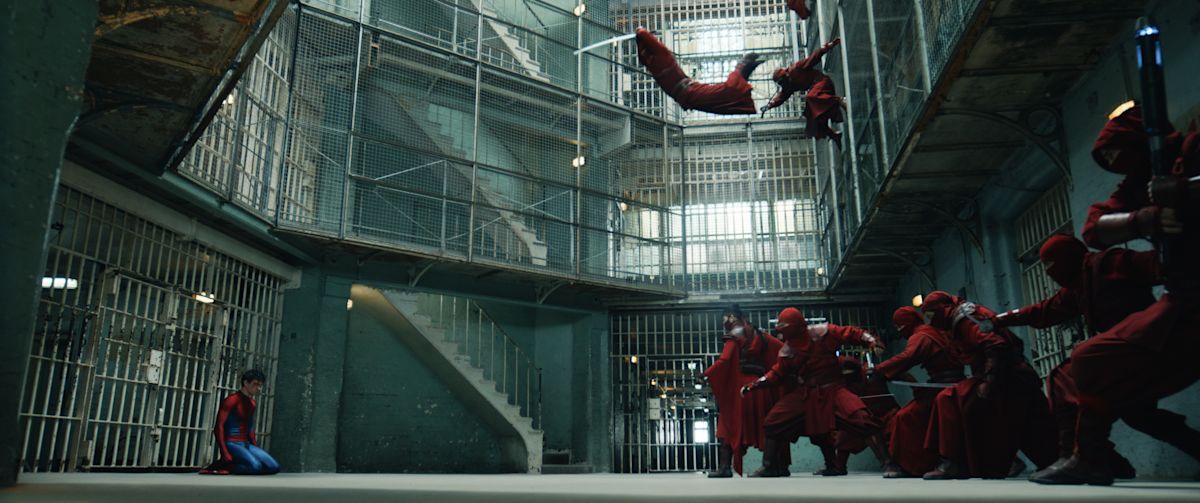
In the film’s final act, the narrative converges on a high-security confrontation at Dorchester Prison. Peter Parker, played by Tom Holland, finds himself in a desperate race to prevent Jean Grey (Sadie Sink) from executing a lethal revenge plot against William Metzger, the head of the Department of Damage Control. To stop him, Jean utilizes her immense psychic abilities to command a legion of ninjas from the mystical organization known as The Hand.
According to stunt designer Peng Zhang, the choreography for this sequence was inspired by a traditional peacock dance performance involving 20 dancers moving in perfect unison. Zhang adapted this concept to the screen by arranging the 20 ninjas into a formation that mimicked a bird in flight. While Jean Grey herself does not fully transform, the collective movement of her “magic ninjas” serves as a visual metaphor for the Phoenix. The central combatant acted as the head of the bird, while the surrounding ninjas branched out to form the wings, creating a unified, hive-mind fighting style that felt both supernatural and disciplined.
Context
Director Destin Daniel Cretton wanted to move away from the “multiverse tedium” that has characterized recent superhero cinema, opting instead for a story that feels more personal and physically immediate. By introducing villains like Tombstone and The Scorpion alongside the mutant Jean Grey, the film grounds the conflict in a more recognizable reality.
The production team faced significant logistical hurdles while filming the prison sequence. Choosing to shoot on location at the historic Dorchester Prison in England meant dealing with thick concrete walls and iron bars that obstructed the view of the stunt riggers. To ensure the safety and precision of the wire-work and martial arts, the crew had to install a complex system of internal cameras so the technical team could monitor the movements of the ninjas from the other side of the facility. This dedication to practical locations was part of Zhang’s mission to ensure the martial arts felt authentic to fans of the genre.
Why it matters
This specific fight scene is significant because it bridges the gap between different eras of Marvel lore. By using The Hand—a group traditionally associated with Daredevil and street-level heroics—and imbuing them with the symbolic imagery of the Phoenix, the film honors Jean Grey’s comic book history without relying on heavy CGI transformations. It provides a visual shorthand for her growing power and her connection to the Phoenix Force in a way that feels integrated into the film’s “grounded” aesthetic.
Furthermore, the emphasis on authentic martial arts combined with Spider-Man’s “alien technology” represents a shift in how Sony and Marvel are approaching action design. By drawing inspiration from traditional dance and real-world fighting styles, Spider-Man: Brand New Day offers a template for future sequels to deliver high-impact spectacle that remains rooted in character and physical storytelling. It satisfies longtime comic readers with its deep-cut references while providing a fresh, kinetic experience for general audiences.