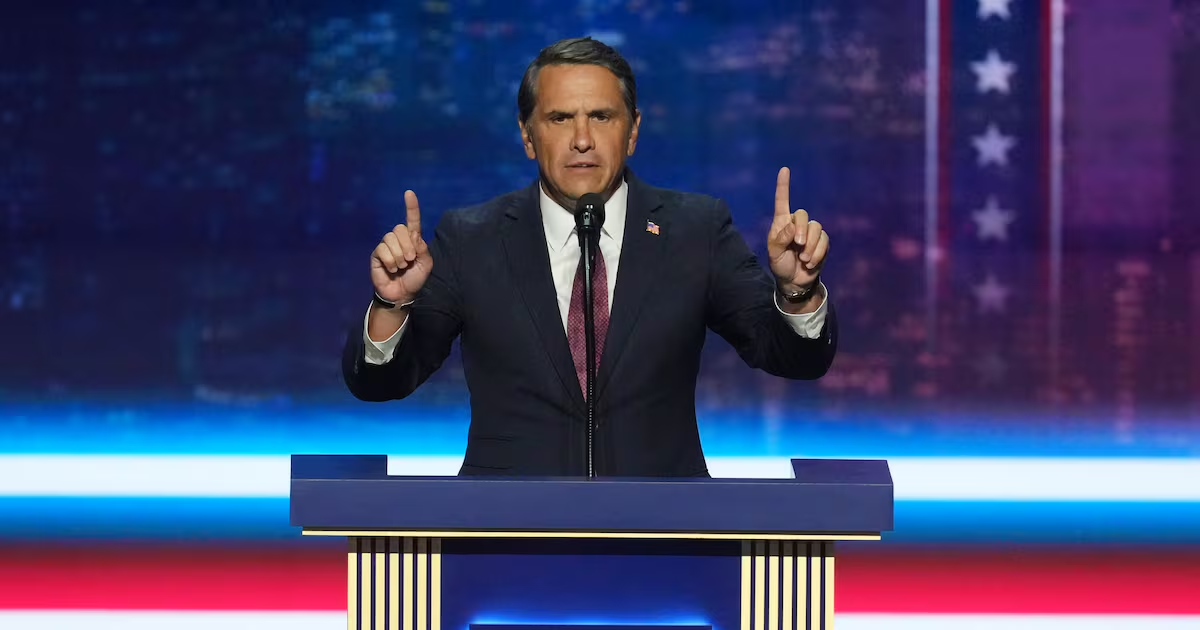
The traditional separation between the United States Department of Justice and partisan politics is facing renewed scrutiny following a series of public appearances by Attorney General Todd Blanche. By taking the stage at explicitly political events, Blanche is navigating territory that has long been considered off-limits for the nation’s top law enforcement official. Critics argue that these actions threaten to dismantle the longstanding norms designed to ensure the public views federal prosecutions as independent and free from electoral influence.
What happened
In recent days, Attorney General Blanche has participated in several high-profile Republican gatherings. This week, he appeared at a campaign event in North Carolina to support a Republican candidate for the U.S. Senate. This follows a previous appearance at a GOP midterm convention, where Blanche used his platform to praise President Donald Trump and champion the administration’s “tough-on-crime” initiatives.
During these events, Blanche’s rhetoric often mirrored campaign talking points, touching on issues such as border security, drug trafficking, and international threats. At a North Carolina event for nominee Michael Whatley, Blanche told the audience that they were safer now than in previous years, specifically crediting the administration’s policies for community safety. These speeches have not been limited to law enforcement topics; Blanche has occasionally drifted into economic discussions, such as inflation and stock market growth, which are typically outside the purview of the Department of Justice.
In response to the backlash, a spokesperson for the Attorney General stated that Blanche’s travel and appearances were cleared by ethics officials and complied with federal regulations. Blanche himself has dismissed the criticism, characterizing his presence at these rallies as a way to engage with law enforcement officers and discuss policy rather than a formal endorsement of political candidates.
Context
For decades, the Department of Justice has operated under a set of unwritten and written rules intended to keep the agency at an arm’s length from the White House’s political interests. Historically, Attorneys General have avoided campaign rallies to prevent even the appearance of partisan bias. This distance is considered essential for maintaining the integrity of federal investigations and the credibility of the judicial system.
Blanche’s tenure has been marked by a departure from these traditions. As a former personal attorney for Donald Trump, his appointment was already a subject of debate regarding his ability to remain impartial. His recent activities have reignited those concerns, with legal experts pointing out that his presence at partisan rallies is a sharp break from the behavior of his predecessors. Richard Painter, a former ethics lawyer during the George W. Bush administration, expressed alarm at the situation, suggesting that the department appears “hopelessly politicized.”
Why it matters
The primary concern among critics and government watchdog groups is the erosion of public trust. When the head of the Justice Department actively participates in partisan events, it can create the perception that legal decisions—including who is investigated and who is prosecuted—are being influenced by political loyalty rather than the rule of law.
This controversy has already led to formal challenges. Public Citizen, a government watchdog group, filed a complaint alleging that Blanche’s participation in these events may violate the Hatch Act, which restricts federal employees from engaging in certain political activities. The group argues that using the prestige of the Attorney General’s office to bolster specific candidates undermines the non-partisan nature of federal service.
Ultimately, the controversy surrounding Blanche highlights a growing debate over the independence of the Justice Department. If the boundary between law enforcement and political campaigning continues to thin, it could have lasting implications for how the American public views the fairness and neutrality of the federal justice system.