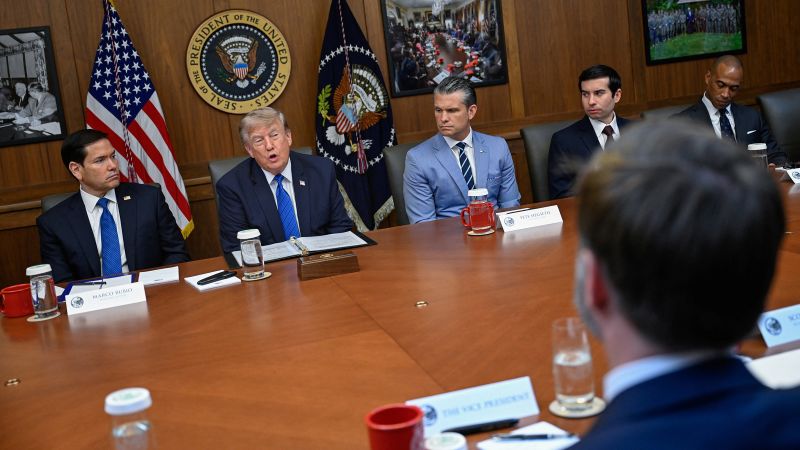
During a recent Cabinet meeting held at Camp David, President Donald Trump addressed a wide range of national issues, including cybersecurity, manufacturing, and immigration. However, several of the President’s assertions regarding domestic rivals and economic data have come under scrutiny for lack of evidence or contradiction with federal records. These remarks come at a pivotal time as the administration navigates ongoing tensions with Iran and shifts in the domestic economic landscape.
What happened
One of the most striking moments of the meeting involved an unsubstantiated accusation against Minnesota Governor Tim Walz. Following a series of cyberattacks targeting local water utility systems across seven states, the President suggested that Minnesota was responsible for the breaches. He claimed the state was “grossly incompetent” and specifically alleged that Governor Walz, the Democratic vice presidential nominee, was behind the activity.
This claim stands in direct contrast to information provided by federal law enforcement. The FBI and the Environmental Protection Agency (EPA) have indicated that the attacks are being treated as the work of foreign actors, specifically naming Iran as a primary suspect. Furthermore, the cyber incidents were not isolated to Minnesota; utilities in at least six other states reported similar disruptions. Governor Walz responded by noting that Minnesota’s experts were instrumental in identifying the vulnerabilities and that the President’s rhetoric ignored the reality of modern warfare and foreign threats.
Context
The Cabinet meeting also served as a platform for the President to highlight his administration’s economic and border security records, though many of the figures cited differ from official government data.
Regarding manufacturing, the President stated that the United States is currently building more factories than at any other point in history. However, federal data on manufacturing construction spending tells a different story. Since reaching a peak during the previous administration, spending in this sector has seen a steady decline. As of May 2026, the annual rate of construction spending stood at approximately $174.8 billion, representing a 28% drop compared to two years prior.
On the topic of inflation, the President claimed to have inherited an economic “catastrophe.” While inflation did reach a 40-year high of 9.1% in 2022, that figure had dropped significantly by the time the current term began. In January 2025, the year-over-year inflation rate was 3.0%, which is lower than the 3.5% rate reported in June 2026. While the President correctly noted a recent sharp drop in inflation, analysts attribute that specific decline to a temporary dip in gasoline prices during a brief ceasefire with Iran, rather than a permanent trend.
The President also repeated contested figures regarding immigration. He claimed that 25 million migrants had entered the country under the previous administration and that nearly 12,000 of them were “murderers.” Federal records indicate that total “encounters” at the border were under 11 million, a figure that includes individuals who were immediately deported. Additionally, the statistic regarding non-citizens with homicide convictions refers to a cumulative total spanning several decades—including the President’s first term—and includes many individuals who are currently serving prison sentences.
Why it matters
The dissemination of accurate information during Cabinet meetings is vital for public trust and informed policy-making. When domestic political figures are accused of orchestrating cyberattacks without evidence, it can obscure the actual threats posed by foreign adversaries like Iran. This rhetoric can also complicate the coordinated response between state and federal agencies necessary to protect critical infrastructure like water systems.
Furthermore, the use of inflated statistics regarding the economy and immigration can skew the public’s understanding of the country’s actual challenges. As the nation prepares for upcoming electoral cycles, the reliance on verified data from agencies like the FBI, EPA, and the Bureau of Labor Statistics remains the most reliable way to assess the performance of any administration and the safety of the American public.