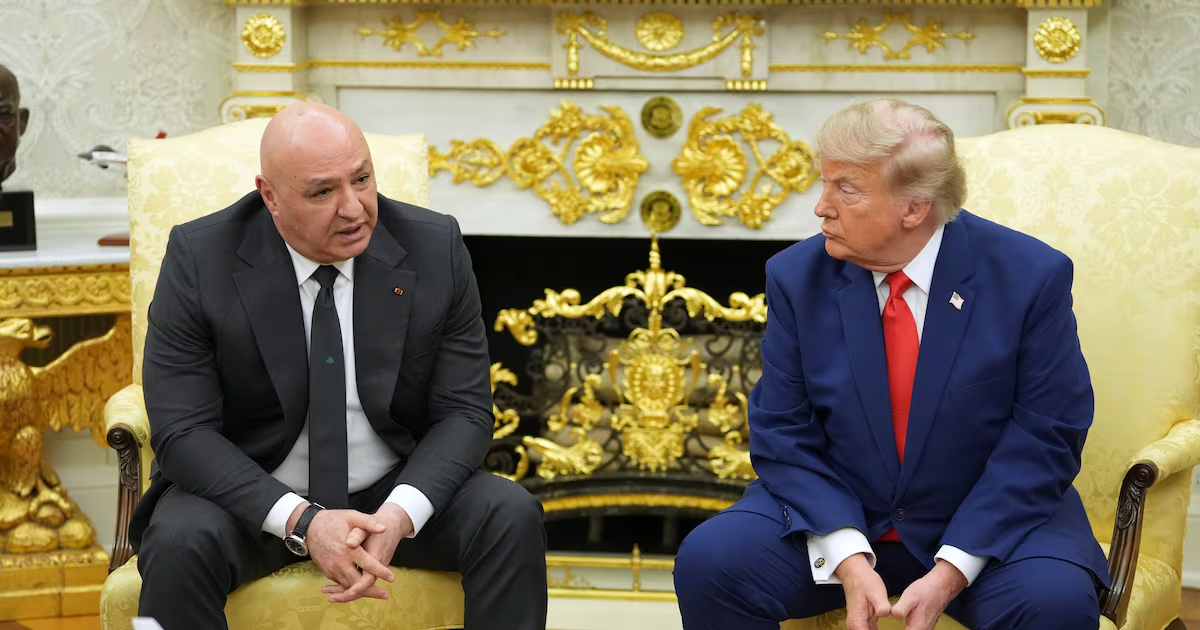
In a significant diplomatic gesture at the White House, President Donald Trump hosted Lebanese President Joseph Aoun on Tuesday to discuss the future of the Levantine nation. Following a period of intense volatility involving Israel and the militant group Hezbollah, Trump committed the United States to a path of substantial assistance for Lebanon, signaling a desire to stabilize a region long plagued by conflict. The meeting underscores a renewed American interest in Lebanese sovereignty at a time when regional tensions remain high.
What happened
During the high-level meeting, President Trump emphasized that his administration intends to provide “a lot” of help to Lebanon. He vowed to accord the nation the dignity it deserves, suggesting a shift toward a more robust bilateral relationship. One of the most immediate and tangible policy shifts announced following the four-day visit was the resumption of direct commercial flights between the United States and Lebanon.
This decision effectively ends a suspension of direct air travel that has lasted more than 40 years. Trump utilized social media to announce that U.S. carriers would soon be permitted to fly directly to Lebanon, allowing Americans easier access to the country. While security questions remain regarding the influence of militant groups near major transit hubs, the move is seen as a major symbolic and economic victory for the Lebanese administration.
Context
The diplomatic breakthrough comes as Lebanon navigates a precarious transition. For nearly 80 years, Lebanon and Israel have technically remained in a state of war. Recent months have seen this historic animosity escalate into active warfare between the Israeli military and Hezbollah, the Iran-backed militant group that maintains a powerful presence in Lebanon.
The United States has stepped in as a primary mediator, facilitating rare direct negotiations between Lebanese and Israeli officials. These talks are centered on two primary, yet complex, objectives: the orderly withdrawal of Israeli troops from southern Lebanese territory and the subsequent disarmament of Hezbollah militants. The current administration has championed these peace efforts even as it remains wary of broader escalations involving Iran, which continues to be a destabilizing force in the Middle East.
Why it matters
This meeting signifies a potential turning point for Lebanese statehood and regional security. A “pilot framework” is currently being implemented to test the viability of a permanent peace agreement. Under this plan, which was initially announced in late June, the Lebanese Armed Forces have begun deploying to specific southern zones—including the villages of Srifa, Froun, and Zawtar al-Gharbieh—as Israeli forces adjust their military posture.
This move is designed to allow the Lebanese central government to reassert its authority in regions that have been under the sway of militant factions for decades. President Aoun lauded the American president’s involvement, describing the peace initiative as a “great vision” and a potential “legacy” for the Trump administration. If successful, the mediated talks could lead to a formal end to the eight-decade state of war, fundamentally reshaping the geopolitical landscape of the eastern Mediterranean. For the U.S., the engagement represents an attempt to foster a stable, independent Lebanon that is less reliant on foreign militant influence.