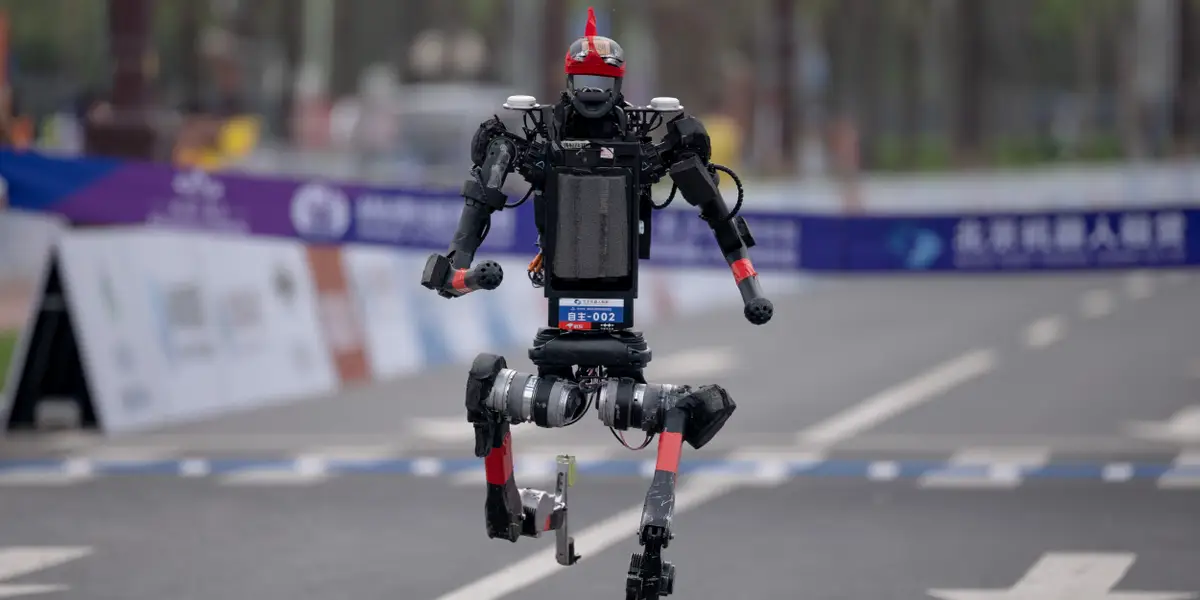
The limits of human athleticism are being challenged not by another sprinter, but by a machine. Unitree, a leading Chinese robotics company, recently introduced a new humanoid robot nicknamed “Superman” that reportedly surpasses the top speeds and jumping capabilities of the world’s most elite athletes. This announcement comes at a pivotal moment for the firm as it prepares for a high-profile public listing, signaling a major leap forward in the competitive global robotics race.
What happened
Unitree’s latest creation, the “Superman” robot, has set a new benchmark for robotic mobility. According to the company, the robot—which was developed in just three months—can reach a peak speed of 12.66 meters per second (m/s). This figure narrowly eclipses the 12.4 m/s top speed achieved by legendary sprinter Usain Bolt during his 2009 world-record 100-meter dash. While Bolt’s record stands at 9.58 seconds, Unitree suggests that its robot could theoretically complete the same distance in just 7.90 seconds if it maintained its maximum velocity.
In addition to its sprinting prowess, the Superman robot possesses extraordinary verticality. The company claims the machine can perform a standing vertical jump of two meters, a feat that would shatter existing human records. Despite these impressive statistics, observers note that the robot’s movement is not yet fluid; it features a somewhat awkward running style and spindly legs, prioritizing raw power and speed over the aesthetic grace seen in some of the company’s previous models.
Context
The unveiling of the Superman robot serves as a powerful marketing tool ahead of Unitree’s initial public offering (IPO) in Shanghai. The firm is seeking a $9 billion valuation, and investor enthusiasm is reportedly high, with retail allocations for the IPO being oversubscribed by more than 5,000 times. This level of interest highlights the massive growth within China’s domestic robotics sector.
Unitree has established itself as a prolific manufacturer in this space. In the first half of 2026 alone, the company shipped nearly 6,000 humanoid units. Their product lineup is diverse, ranging from the consumer-friendly G1 humanoid—which recently gained fame for performing kung-fu and backflips—to the massive GD01 mecha designed for heavy-duty tasks.
While Chinese firms are rapidly scaling production, U.S. competitors are still working toward mass commercialization. Tesla’s Optimus robot is not expected to enter production until late 2026, though several American startups are aiming for limited deliveries to customers by the end of this year.
Why it matters
The “Superman” robot represents more than just a speed record; it is an indicator of how quickly the humanoid robot market is maturing. Analysts at Morgan Stanley have estimated that this industry could be worth as much as $7.5 trillion by 2050. As these machines become faster, stronger, and more capable, the transition from “flashy demos” to practical applications in factories and service industries becomes more likely.
However, the rapid advancement of Chinese robotics has also triggered regulatory responses in the West. The Federal Communications Commission (FCC) recently implemented a ban on certain new foreign-made advanced robots, a move that could limit Unitree’s access to the U.S. market. This geopolitical tension suggests that the future of robotics will be shaped as much by trade policy as by engineering breakthroughs.
While the Superman robot’s claims have yet to be independently verified by outside organizations, its existence underscores a clear trend: the gap between biological potential and mechanical performance is closing faster than ever before. For industries looking to automate complex physical tasks, these high-performance humanoids may soon move from the laboratory to the front lines of the global economy.